
What is counseling and what can it do for you?
Counseling is enormously relevant in the times we live in today. Many people lose their balance as society moves faster and faster, the pressure to keep up with the rat race is high, and social connections have become fleeting and superficial. In addition, individualization, digitalization, and an overload of information and stimuli are causing growing numbers of people to experience stress, emotional complaints, a sense of emptiness, and a search for meaning.
In this blog I explain what counseling is, why it is particularly suited for stress, emotional challenges, and life questions, what you can expect from a counseling process, and how counseling differs from coaching and therapy.
What is counseling?
Counseling is accessible, person-centered talk therapy in which you receive support with questions or challenges in your life or work. These questions or challenges can relate to yourself, your relationships with others, or circumstances that affect your life. In person-centered therapy, you as a person — and how you experience and perceive situations — are central.How did counseling originate?
Counseling originated in the first half of the 20th century. It has its roots in humanistic psychology, which is based on your natural ability to grow and develop your own potential. The American psychologist Carl Rogers (1902–1987) is one of the founders of counseling. Rogers believed that counselors should guide clients with empathy, genuine attention, and unconditional acceptance. That remains the core of counseling to this day.What questions and concerns can you bring to a counselor?
You can bring all kinds of questions to a counselor. Together we look at what lies beneath your questions or concerns and what they are trying to tell you. I work primarily with people who feel restless on the inside. That restlessness can have various causes. Below I have listed a few:- Stress and tension
- Difficulty dealing with emotions
- Worrying and ruminating
- Strong self-criticism
- Life questions and existential themes
- Problems at work or in relationships
- A sense of emptiness
- Searching for meaning
- Grief and loss.
What happens during a counseling session?
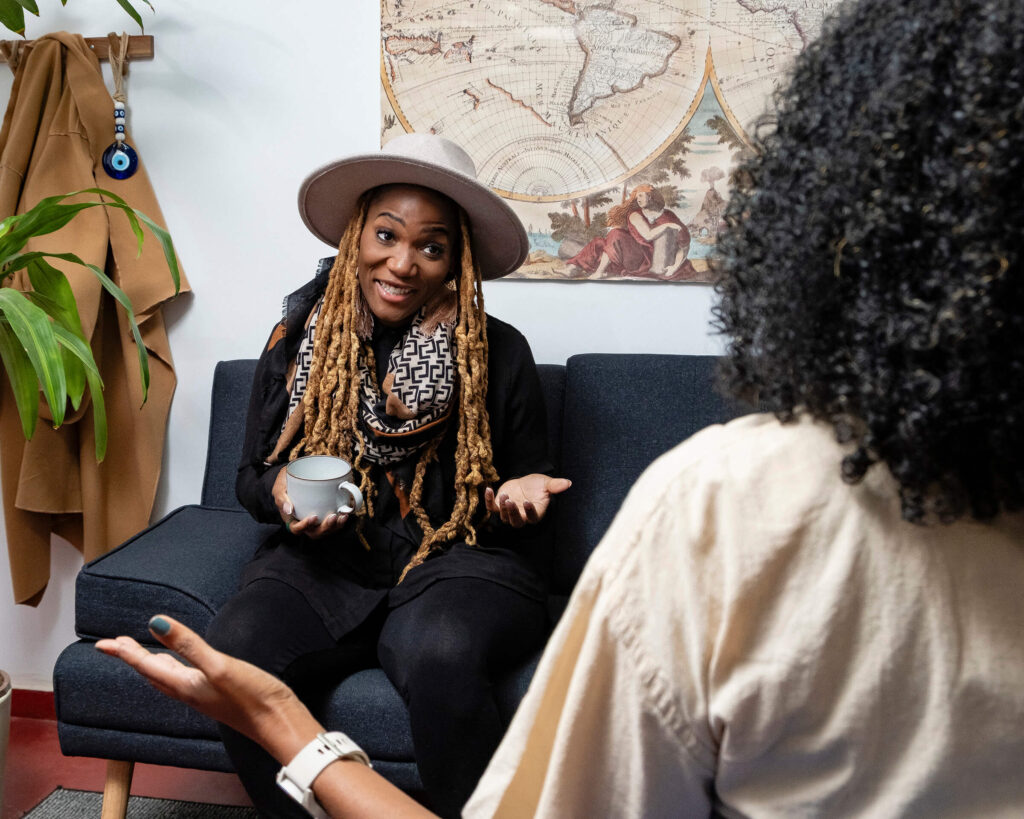
During a counseling session we discuss what is on your mind at that moment. The session is an open and confidential conversation in which you are central. It is a place where you are free to think out loud, feel, and explore — without judgment or pressure. You don’t need to have it all figured out or know the right answers. A counseling session is not a place where you get fixed, but where you create space to better understand yourself, others, and the situation, and where each conversation brings you closer to a solution. A counseling session moves at your own pace. The counselor listens, asks deeper questions, and helps you gain insight into your thoughts, feelings, and patterns. The session is not focused on quick solutions, but on clarity and awareness. From there, space for change often arises naturally. Many people experience after a session:- more calm and overview
- clarity about what is going on
- insight into themselves and their situation
- tools to approach situations differently.
What can you expect during the counseling process?
Your needs and support question determine the length of the counseling process. Broadly speaking, a counseling process unfolds in three phases. Below I briefly explain each one.1. Clarification
The clarification phase focuses on understanding your support question and situation. Together we explore what is going on, what complaints or questions you have, and what thoughts, feelings, and patterns play a role. By giving space to your story, insight and overview emerge — which often brings relief in itself.2. Goals
In this phase we formulate concrete and achievable goals together. What do you want to change, develop, or experience differently? The goals give direction to the rest of the counseling process and align with your needs, possibilities, and pace.3. Action
In the action phase you begin applying new insights in your daily life. This may mean learning to handle situations differently, making new choices, or breaking certain patterns — so that you work step by step toward greater balance and resilience.Counseling is suitable for you if you are mentally healthy and are temporarily seeking support with a challenge in your life or work.
Difference between counseling and coaching
I often get the question: what is the difference between counseling and coaching? Counseling sits roughly between coaching and psychotherapy and usually focuses on mild to moderate complaints and life questions. Counseling and coaching resemble each other, but differ mainly in focus and depth. Counseling helps you by exploring underlying feelings, beliefs, and patterns — and how you want to deal with them and create change. You discover your own answers and solutions so that you experience more balance mentally, emotionally, and on a deeper level. Counseling is therefore a deepening process in which you remain in control. Not a method, theory, or the counselor determines the direction — your experience, needs, and question are central. Coaching is a trajectory in which you work with a coach to look at what you want to change in your life or work. The focus is on the future and on what you can concretely do. Your wishes and questions are translated into achievable goals and practical steps, so that you can try out and evaluate new behavior and new choices. Where counseling primarily creates space for feelings, beliefs, and patterns from the past or present, coaching focuses more on your qualities, developing skills, and achieving goals and visible results. Coaching is a component of the counseling process, particularly in the action phase. The attention then shifts to the future: how do you want to move forward, what direction suits you, and what steps can you take?Difference between counseling and therapy
Counseling falls under psychosocial and social advisory services and is an accessible form of talk therapy. In counseling, no medical diagnoses are made, as is the case within psychology and psychotherapy. Psychotherapy is used for a wide range of psychological problems, from mild to severe disorders and persistent patterns, such as depression, anxiety disorders, personality disorders, and complex emotional or relational difficulties. This often takes place within mental health care, using treatment methods such as cognitive behavioral therapy or EMDR.Is counseling right for you?
Counseling is suitable for you if you are mentally healthy and are temporarily seeking support with a challenge in your life or work. When you want to pause and reflect on yourself and your life, break patterns, and move from inner restlessness toward more peace within. You don’t have to be stuck to benefit from a good counseling session — sometimes a conversation can work preventively.Case:
Brenda (51) came to me because she felt restless and low, while she seemingly had everything in order: enjoyable work, a loving family, and a good life. Yet life felt like a 6 out of 10 to her. Together we explored where these feelings came from. Brenda discovered that she had never really taken the time to process the loss of her father, who had passed away from cancer five years earlier. She still missed him every day. I guided Brenda through her grieving process and through experiencing and processing the emotions that came with it. As a result, she was able to give the loss a place, and the heavy feeling that had hung over her life like a shadow disappeared. Life went from a 6 to a strong 8.5.Counseling by Eunice Frijde
In my counseling, Western psychology and Eastern wisdom come together. Since 2006 I have practiced Buddhism and followed trainings in energetic work, meditation, and mind training. I believe that Western and Eastern psychology strengthen each other, and I therefore work with both. Life once felt to me like a shoe a size too small. That was painful, because I felt I could not freely be myself. In the end, I changed course and found my happiness. Since 2016 I have been living happily in southern Spain, together with my life partner Jesús. I have experienced how liberating it is to make choices that truly suit you. What appeals to me about counseling is its humanity. You and your needs are central. Not a theory, not a fixed method, but you as a person. I guide you with all my heart.Interested in counseling? Book a free introductory call now.
Ook interessant voor jou
Over de auteur
Ik geloof dat een mooiere wereld begint bij gelukkige, bewuste en veerkrachtige mensen. Daarom draag ik bij aan wat ik een spirituele revolutie noem: een verschuiving waarin bewustzijn even belangrijk is als uiterlijk succes.